About
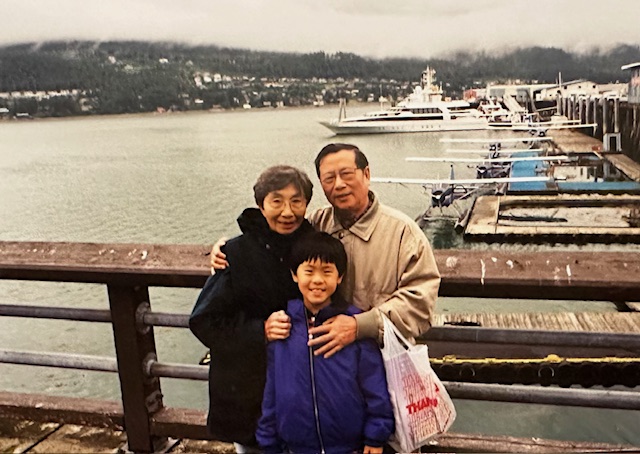
It’s been nearly 3 years since I interviewed my grandfather as part of my family's oral history project. For the project, I flew over to Taiwan for about a week, and I sat down with him each morning and recorded roughly 8 hours of interview footage by the time I left. It remains one of the most cherished experiences of my life. Each year I’ve told myself that I’ll start editing the material and writing his story, and yet 3 years have passed with too little to show for it. I’m too busy, I say, or I’ll do it tomorrow. Truthfully, it’s been difficult to find the right words to perfectly capture the essence of these stories, and moreover, it’s also just emotionally painful.
It’s painful to rewrite an episode about my grandfather fleeing his ancestral hometown like a common fugitive in the dead of night under the cover of darkness; it’s painful to envision him living in Taiwan in the aftermath of the civil war as a homeless soldier among thousands of homeless soldiers, yearning for his family in a backwater foreign land; and it’s painful to contemplate him, nearly 50 years later, furtively sending a captionless photo of him and his wife and children, smuggled by a friend, to his mother and surviving siblings in China who for all this time knew not whether he was dead or alive, and vice versa.
As I examined these stories, I learned that they also help explain why I always tear up at weddings of the sons/daughters of first-generation immigrant families when I look closely at the parents of the bride or groom.
We have never met, but I feel like I know you.
Because when I see their faces wet with tears of joy I think that they are not such distant cousins to their tears of sorrow and pain, for in the intensity of their joy I can also sense the literal and metaphorical oceans which were crossed in order to arrive at this very moment –against all hardships and all odds, against all language barriers and cultural barriers and political barriers, against overt or covert discrimination, and against the subordination of any dreams and aspirations they themselves might have harbored once upon a time in the peaks of their idealistic youth – all of this they’ve endured and more, and not even for any promises but just for a chance at a better life for their future generations.
And in this moment of joy, it’s as if the sacrifices they’ve made to get here are suddenly crystallized, if only for an ephemeral moment, and I see a generational journey toward an uncertain future finally realized.
There is an inevitable level of cultural assimilation that we children of immigrants must accept by living in America. Year by year, the native language your parents taught you at home slowly slips away; your vocabulary dries up, your speech trembles, and your pronunciations begin to sound foreign inside of your mouth; the words and characters that you learned (via dreaded Sunday schools) growing up increasingly begin to resemble hieroglyphics inscribed by aliens. Even faster to fade from memory are the lore and stories behind your culture wisely contained in those depthless three and four character axioms. Some time after I graduated college, it struck me that my knowledge of even contemporary Chinese history was very limited to mostly things that were taught to me in school, and importantly, through a western lens; only the stories of the ‘winners,’ or those who are subjectively deemed worthy, were distilled down into canonical knowledge.
The reality is that outside the pages of history as we’re taught, there are thousands of stories out there that deserve to be told which are simply swept under the rug. I believe there is great power in remembrance, and by simply doing so, we honor these stories and pay tribute to the silent sacrifices that have made possible our present day lives in America. Even as I tell these stories today, I cannot help but get very emotional. In social settings it sometimes feels embarrassing, and I’ve often wondered why I react so strongly to them; After all, these are someone else’s memories – memories of events that happened years or decades ago, well before I was born. Why should they have such a hold on me? I realized then that though these memories are not my own, they are still a part of my family and therefore, still a part of me; the struggles that my grandparents endured were passed down to my mother, who then distilled them into her own system of values which were then passed down to me; despite the passage of time, these multigenerational memories are very much an integral part of what makes me who and why I am today.
And so, Languages of Our Parents is a tribute to our parents, grandparents, and ancestors by sharing and remembering their stories and lives. It is also a reclamation of the bits and pieces of our culture and history that have long lain dormant in our memories. If you have a story that you’d like to tell, I would love to share it here.
Sincerely yours
- the unnamed author.